The Sasumata: from the Edo Period
to Modern Restraint
The sasumata is a long-handled Japanese restraint tool with a U-shaped fork at its end, designed to hold a person at a safe distance. In use since the Edo period, it remains common security equipment in Japan today. This page traces its history and present-day use.
What is a sasumata?
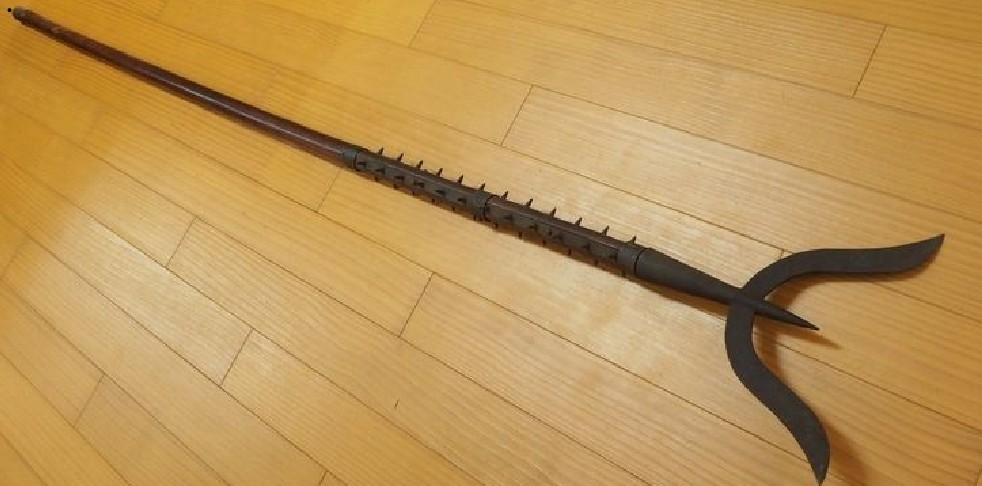
The sasumata (刺股, "spear fork") is a restraint tool mounted on a long shaft, with a U-shaped fork at the end. It is used to pin a person's arms, legs, or torso against a wall or the ground, allowing the user to control them while staying out of reach. A traditional sasumata was around two metres long, with a wooden shaft reinforced by iron fittings.
Origins in the Edo period
During the Edo period (1603-1868), under the Tokugawa shogunate, policing was entrusted to samurai and low-ranking officers. The state sought to avoid unnecessary bloodshed, especially in densely populated cities such as Edo (Tokyo), Osaka, and Kyoto. Law enforcement therefore relied on tools that allowed suspects to be captured alive, for trial.
The sasumata was one of the torimono sandōgu - the "three tools of arrest" - alongside the tsukubō (push pole) and the sodegarami (sleeve entangler). The three equipped guard posts (bansho), checkpoints, and magistrates' offices. They were also symbols of authority, often displayed in front of police posts.
Historical note: sasumata of the period often had spikes or blades on the shaft near the head, to stop a suspect from grabbing the weapon. It was a non-lethal tool by the standards of its time, but not a painless one.
From decline to reintroduction
With the Meiji Restoration (1868) and the modernisation of the police along Western lines, the torimono sandōgu, including the sasumata, gradually disappeared from regular police use, replaced by firearms, batons, and handcuffs. The sasumata nonetheless survived as a cultural artifact and a training tool in some traditional martial arts schools.
After the Ikeda Elementary School massacre in Osaka in 2001, many Japanese schools sought non-lethal means of defending against intruders. Modern sasumata, typically made of aluminium with blunt forks, were introduced as emergency restraint tools. Today the great majority of staff rooms in Japan are equipped with one.
The sasumata today
The modern sasumata is used in schools, banks, shops, and some institutions as a visible deterrent and an emergency restraint tool, pending the arrival of law enforcement. In November 2023, an employee of a Tokyo jewellery shop drove off three robbers with a sasumata, an incident that drew nationwide attention in Japan. Some police units also retain modern sasumata for particular situations.
The evolution: the CERBERUS series
The classic U-shaped design has a known weakness: a person can grab the shaft and push it back towards the user. That is the problem the CERBERUS series by Sanokiko set out to solve. Developed from 2011 at the request of Tochigi Prefectural Police, it gives the sasumata a restraint head that locks and then detaches from the shaft in an instant - without spikes, and engineered to minimise the risk of injury.
Sources: Wikipedia (Sasumata; Torimono sandōgu; Ikeda school massacre); Don Cunningham, "Taiho-jutsu: Law and Order in the Age of the Samurai" (Tuttle, 2004). This page is provided for information.
← Back to home